


A Ukrainian Jewess in Poland

Eliza Schwartzman
She grew up in an environment of extreme anti-Semitism. She fled her war-torn country for safe haven in another where she was able to publicly embrace her Jewish roots. Eliza Schwartzman is not your typical Polish “Hidden” Jew. In fact, the 21-year-old studying IT and business at the Krakow University of Economics isn’t Polish at all – she grew up in Dnipropetrovsk, Ukraine.
But as tensions between Russia and Ukraine increased in recent years, her parents sent Eliza at the age of 16 to Poland for her studies instead of attending a local university closer to home. That proved to be prescient: two years into her stay in Krakow, full-fledged war broke out in Ukraine and Eliza knew she’d made the right choice. Now she’s hoping her parents and younger sister will be able to follow her.
In this special profile, Eliza talks about what it was like growing up Jewish in Ukraine, the blatant anti-Semitism she experienced, and the warm welcome she’s received from the Polish Jewish community in Krakow.
BONUS: Working together with Rabbi Avi Baumol, Shavei Israel’s emissary to Krakow, Aliza has posted a version of her story on the Times of Israel website. You can read it here.
Tell us about growing up in Ukraine.
I was born in the eastern part of Ukraine in 1994. Although the Soviet Union had just collapsed, the pressure and influence from Russia still existed and the attitudes towards Jews remained the same as they were during the days of Communism. So if you had an opportunity to keep the fact that you were Jewish a secret, you’d better do it. There were all kinds of terrible attitudes. One was that if there were no water in a building, people would say that, “the Jews must have drunk it all.” My mother said that all her life, she did her best to hide this attitude of the world around her from her children.
Were both of your parents Jewish?
My father is Jewish and it is written in all his family documents. My mother’s side is more complicated. If you were to ask my grandmother about her roots it’s almost the last topic she would like to discuss. A few months ago when I visited her, I overheard my grandfather angrily saying to my grandmother, “How in the world did it happen that I married a Jewish woman?”
Why was he so upset?
To understand the problem, you would need to live in my country. Religion was prohibited, churches and synagogues were destroyed, priests were killed. My mother told me that when she was little girl there was an obligatory lesson in school called “atheism.” After World War II, people were forced to hide their religion and never to speak about it. The result was that their children, who were born in the middle of the 20th century, mostly didn’t believe in God and under the pressure of propaganda didn’t even try to learn more. So, if there were problems for Christians, you can’t even imagine how it was for the Jewish people. A Jewish man would never receive the highest position in an organization. There was an almost official policy of “No Jew in the director’s chair.” My father experienced this all his life.
What was your father’s experience with anti-Semitism?
My father is a very talented engineer, a brilliant manager and leader. But he never received a position from the government in any of the leading factories. He was, however, once given a “dying” factory. The authorities didn’t have any choice because the previous director had made the bad situation that already existed in the factory even more catastrophic. They had to hire a new director and there were no better candidates to do it than my dad, even though he was Jewish. No one expected big changes. The factory had never been profitable. So imagine how surprised they were when, after two months, the factory had not only cut out all waste, but for the first time showed a profit!
Did your father try to hide his Jewish identity?
It started from my grandfather – he changed his name as an adult from Moses to Michael. When I was born, my father didn’t give me his surname. He was afraid that all these horrible things that were following him and his family all their lives would happen to me as well. The attitude from my parents was: “Never talk about your roots, never discuss it. The best thing you can do is to be silent. Silence is golden.” But I wasn’t comfortable with this. I couldn’t understand it. One time, when I was in the first grade, all the children were talking about themselves, who they are, who are their parents, what do they want to do in their lives. When it was my turn, I stood up proudly and in a loud voice informed everyone that I’m a Jew.
How was that received?
Not well. My teacher decided to call my parents, to tell them what happened and to ask them to make me think about my behavior and to teach me never to say those words again. That was the first time I met anti-Semitism in my life. I was only six-years-old. The truth is, I didn’t really know what it meant to be a Jew back then. I loved and respected my father so much that I wanted to be like him. But, still, this happened in a free country, in the 21st century.
Did you speak out again?
Not for many years. I really internalized that lesson, not to speak about being Jewish again. But in Ukraine, when you turn 16, it’s time to receive your own passport. And in your passport, you can choose to use either your father’s or your mother’s surname. You can change it without any complications. I realized that I wanted to become Schwartzman, my father’s surname. I asked my mother if I could do this and she agreed. My father found the question so “abnormal” that he didn’t even take it seriously. But I did it. I changed my surname and I felt like the thing that should have been fixed a long time ago was finally done. I hope that my father, somewhere in his heart, is proud. But I know that he will never openly say that to me because he always wants to protect me.
Did your new surname cause you any problems?
Yes. I had one more year left in high school in Ukraine, and there were so many questions from the students and from the teachers. I didn’t like it, but I felt like this was none of their business so I tried not to care too much. The next year, I left to study in Poland.
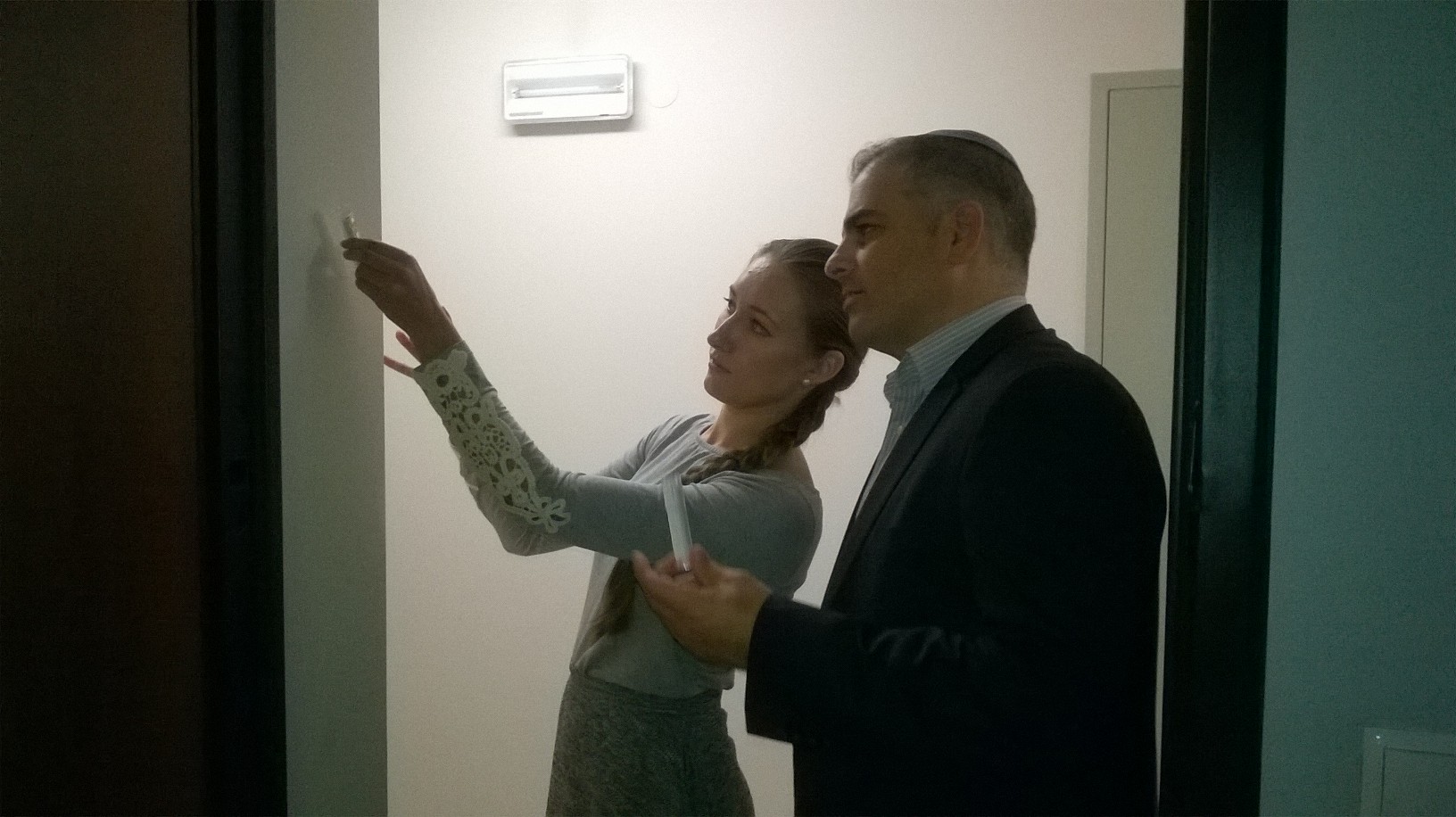
Eliza affixing mezuza to her door with Shavei Israel emissary Rabbi Avi Baumol
Why Poland?
I saw an advertisement on TV that said you could come to study IT (Information Technology) for free in the European Union. There is a lack of IT specialists in Europe, so a special grant was established. You needed to pass your exams back home with high marks and receive certain specializations. I had done both. I received the grant and was told I could start studying in Krakow in the coming two months. My parents were in favor. They felt that a Ukrainian diploma would only be accredited in Ukraine and Russia, but a European degree would allow me to work all over the world. In the worst-case scenario, if there was a war in Ukraine, I could go to another country to work and be safe. That sounded like a joke, but after I was living for two years in Poland, that worst-case scenario became true and I knew I’d made the right choice.
Where are you in your studies now?
I’ve already received my first degree in IT and now I’m in my last year of my master’s degree, writing my thesis in business administration. I still hope that the war will stop and I will be able to return to Ukraine to help my parents in their businesses.
Do you work, too?
Mostly I’m studying, but if my schedule allows, I try to work. Last year, I was the assistant producer for a Ukrainian television travel show, which came to Krakow to film an episode. During the summer, I volunteered in the Krakow Jewish Culture Festival.
When did you get involved in Jewish activities in Poland?
Not immediately. After all the pressure in Ukraine, I didn’t even think about it. It was always such a taboo topic at home. My father used to go synagogue in Ukraine. When I asked to go with him, or to sign me up for classes in Judaism, he always rejected the idea. After a while, I just got used to it. After four years of living here, I decided to stay in Poland, and not return to Ukraine for the summer. That’s when I got involved in the Krakow Jewish Culture Festival. I hoped that it might bring me closer to this “mysterious Jewish world” from which I had been ”protected.” During the preparation for the festival, we had a lecture at the Jewish Community Center about the Jewish people from Rabbi Avi Baumol [Shavei Israel’s emissary to Krakow]. He briefly explained everything we need to be aware of to be helpful during the festival. Most of the volunteers are not Jewish, but Rabbi Baumol mentioned that if there was anyone here who has Jewish roots and who is interested in becoming a part of the community and learning more, they may join the JCC.
Was that the turning point?
Yes, I spent that entire evening preparing my documents and already the next morning I asked to become a member. It’s been six months now. I’m a shy person, so becoming a part of something absolutely new and huge was a very stressful experience. But I was met with such kindness and friendliness, I forgot all about the stress in a moment. After the four lonely years I had spent in Krakow without my family, I felt that in the end I found a new one. I never thought that my life could be so colorful and interesting!
What do you do as a JCC member now?
Every week there are Shabbat dinners, student events and Hebrew classes. These activities, which take place almost every day, gave me an understanding of what it means to be a part of community; that there is a place and a people that I want to see every day. And one more thing that’s very important: Studying. First, I was just quietly listening to the stories Rabbi Baumol would tell during Shabbat dinner. Then one day I asked my friends in Krakow to take me to synagogue with them. Now I’m trying to participate in all of the rabbi’s classes, which take place at least four times a week. I feel that I have found a place and a person who can teach me everything I need to know.
What is your relationship to your Jewish roots now?
Everything I’ve experienced in Krakow through the JCC and Rabbi Baumol makes me strongly feel the difference between the world in which I was living in Ukraine and the world in which I’m living now. Probably a lot of time will pass until I will have the courage to loudly and proudly speak of my roots again, like I did when I was six-years-old, but at least right now I’m not afraid to be a part of it. I feel like being a part of this community is changing me for the better. I love those changes so much.